
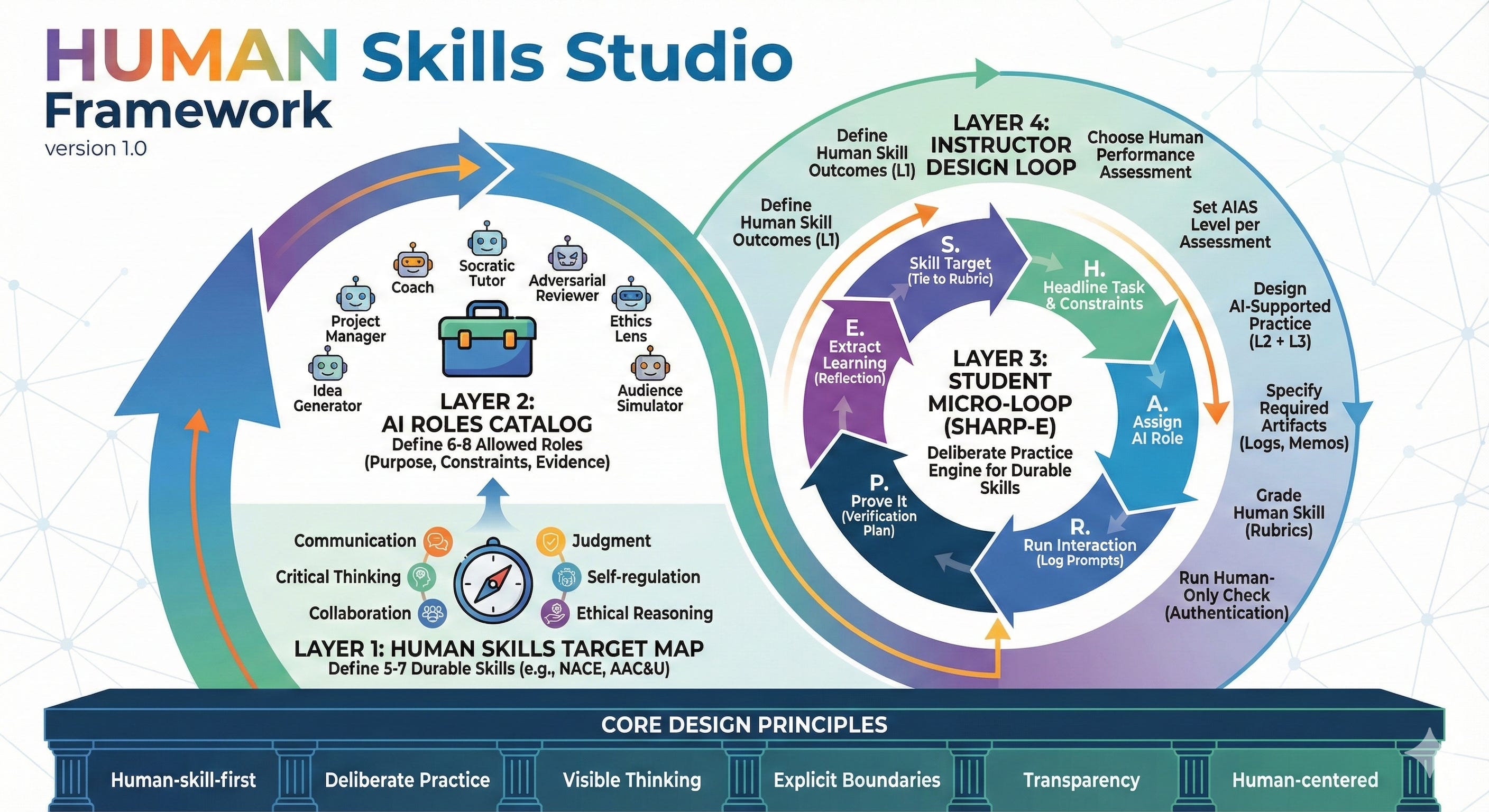
HUMAN Skills Studio Framework
A teacher-centric playbook for turning GenAI into a deliberate practice engine

WARNING: This is not my normal practical, how-to kind of post. This is a post sharing my thoughts and work on developing an outline for a practical framework to guide teachers in how to guide college students in using generative AI technology (like ChatGPT) in ways that enable them to deeply develop their human skills (what most folks call “soft skills”).
I’m still researching, and gathering TONS of feedback as I continue to iterate on these ideas. PLEASE share your thoughts, any critiques, and any relevant resources as a comment!
Step 1: What other frameworks already exist, and what they miss for human skills
Most frameworks cluster into five groups. They’re robust, but they’re not “human-skill-first”. They mostly answer “How do we manage AI use?” not “How do we deliberately grow judgment, communication, collaboration, and character using AI as a training partner.”
1) AI literacy progressions
Common structure: Understand → Use → Evaluate → Create.
Barnard’s AI literacy pyramid uses four levels: Understand AI, Use & Apply AI, Analyze & Evaluate AI, Create AI. It’s designed to create shared language and scaffold people from basics to creation, without assuming everyone must become an AI user. Atlis
UNESCO’s AI Competency Framework for Students is bigger and more formal. It outlines 12 competencies across four dimensions (human-centred mindset, ethics of AI, AI techniques and applications, AI system design) with progression levels Understand, Apply, Create. UNESCO
EDUCAUSE ALTL frames AI literacy in higher ed across technical, evaluative, practical, and ethical dimensions and emphasizes durable principles that survive tool churn. EDUCAUSE
Digital Promise AI literacy framework centers literacy as the ability to understand, evaluate, and use AI systems safely and effectively. ERIC
What they do well: give institutions a shared developmental ladder.
What they miss for my goal: they don’t operationalize human skills as the primary target; they treat them as side effects, not as the syllabus.
2) Task-level workflows
Here an example is the PAIR (Problem, AI, Interaction, Reflection) framework, which is a simple loop students can run on any assignment.
King’s College London’s guidance on PAIR is more explicit about why it matters: avoid over-dependence, keep developing judgment and creativity, and ground the approach in being human-centric, skill-centric, and responsibility-centric. King’s College London
What PAIR does well: adds “stop and think” at the start and end, not just prompting in the middle.
What it misses: it’s still AI-centered. It doesn’t force me to specify which human skill is being trained, what deliberate practice looks like, and what evidence will prove skill growth.
3) Assessment integration frameworks
The AI Assessment Scale (AIAS) is one of the most practical tools I found for turning policy into consistent assessment design. It defines five levels from “No AI” through “AI planning, collaboration, full AI, AI exploration,” with student-facing expectations.
University of Colorado Boulder provides implementation guidance and rationale at each level. Notably, they frame Level 2 as supporting deeper engagement, critical thinking, and tutoring, while still requiring students to author the final work. University of Colorado Boulder
What AIAS does well: stops policy chaos. Aligns allowed AI use to learning outcomes.
What it misses: it doesn’t tell me how to use AI to deliberately train human skills. It only tells me how much AI is allowed.
4) Integrity and disclosure frameworks
A lot of university guidance has converged on the same spine: clear policies, disclosure, and academic integrity.
Princeton’s “Disclosing Generative AI” page is blunt. Failure to disclose AI output, even when AI is permitted, is a scholarly integrity violation, and they provide a template. Scholarly Integrity
Many teaching centers emphasize repeated policy communication in syllabus, assignment directions, and in-class. Center for Teaching Innovation
What these do well: reduce ambiguity and “I didn’t know” excuses.
What they miss: integrity is necessary but not sufficient. I can have perfect disclosure and still produce shallow learning.
The core gap across almost all frameworks
They aren’t built around a training theory of human skill development.
If a framework doesn’t explicitly embed deliberate practice and self-regulated learning, I will get AI-fluent students who are still shallow thinkers.
Deliberate practice requires targeted goals, challenge, feedback, repetition, and refinement.
Self-regulated learning is commonly modeled as cyclical phases of forethought, performance, and self-reflection.
UNESCO’s GenAI guidance explicitly pushes a human-centred approach where AI serves the development of human capabilities, and warns GenAI can encourage shallow outputs if not used purposefully.
That is the leverage point for a better-than-existing-frameworks framework.
Step 2: What it takes to build a robust framework in higher ed
A robust framework has to be a tested system with: (1) clear constructs, (2) observable behaviors, (3) assessment evidence, and (4) an update mechanism.
Here is the strongest process stack I’m working on for this framework:
1) I start with backward design, or I will build a vibe, not a framework
Backward design is explicit:
I identify desired results, 2) determine acceptable evidence, 3) plan learning experiences. Teaching & Learning Innovation
In this context, this means: I define human skills first, then decide what student work will prove the skill, then design AI-supported activities that produce that work.
2) Treat it like design-based research, not a one-shot policy
Design-based research is an iterative, evidence-driven approach for authentic learning environments. A commonly cited structure is four phases with iterative cycles, aiming to produce transferable design principles.
Translation: I need to pilot the framework in real courses, collect evidence, refine, and only then declare it “the framework.”
3) Borrow competency framework development discipline
Competency frameworks are value-laden and can steer curricula and assessment. Validation is about the credibility of the claims a framework makes, tied to its purposes and evidence. ERIC
Practical build guidance from the competency world includes:
start broad then get granular
include broad stakeholders
manage scope creep
validate and revise
treat the document as living and updateable
4) Design for governance and drift
AI tools, policies, and institutional risk tolerances change quickly. A framework needs an explicit review and revision cadence and a process for updating allowed tools, privacy guidance, and assessment patterns.
UNESCO’s guidance highlights governance, data protection, and a human-centered approach as foundational. UNESCO in the UK+1
5) Define validity claims upfront
If I can’t state what a framework claims to improve, I can’t validate it.
A clean set of claims for my context:
Students will demonstrate measurable growth in target human skills (as operationalized by rubrics).
Students will demonstrate responsible, transparent genAI use aligned to policies.
Students will demonstrate improved metacognition and self-regulation around genAI-assisted work.
Then I build evidence streams for each claim.
Step 3: Outline for an improved framework that is explicitly about human-skill growth using GenAI
If a framework does not change assessment design, I’m wasting my time.
Students will optimize for grades, and AI will happily do the work. A framework must make the human part the highest-value part.
A working name
HUMAN Skills Studio. A professor playbook for turning GenAI into a deliberate practice engine.
The draft purpose
Help professors design courses where students use GenAI transparently as a coach, critic, simulator, and sparring partner to build durable human skills through deliberate practice, reflection, and authentic performance.
Draft core design principles
Human-skill-first, tool-agnostic
Start from durable human competencies (communication, judgment, collaboration, self-regulation, ethical reasoning). Tools change weekly. Principles survive. EDUCAUSEDeliberate practice beats “AI convenience”
AI is used to create more reps, sharper feedback, and tighter reflection loops, not to replace the hard part. American Psychological AssociationMake thinking visible
Require process artifacts: annotated prompt logs, decision rationales, verification notes, before/after drafts, reflection memos, etc.Boundaries are explicit and aligned to learning outcomes
Use a shared scale (such as AIAS or equivalent) to specify allowed AI use per assignment, per level, and assess accordingly. Stirling Learning EnhancementTransparency is non-negotiable
Disclosure is part of scholarly integrity and part of the learning process. Scholarly IntegrityHuman-centered and equitable
Don’t design a framework that assumes paid tools or invites privacy violations. UNESCO’s guidance stresses human-centred use and governance, and warns about controversies and implications. UNESCO in the UK
Framework architecture
Layer 1: The Human Skills Target Map
Pick a short set of human skills. Don’t invent your own from scratch - use established taxonomies, then customize.
Suggested base (because it maps cleanly to higher ed outcomes and employer expectations):
NACE Career Readiness competencies as the “industry-facing” set (communication, critical thinking, teamwork, leadership, professionalism, equity and inclusion, career self-development, technology). Source
AAC&U VALUE rubrics as the assessment-ready definitions (critical thinking, oral communication, teamwork, ethical reasoning, integrative learning, etc.). Wisconsin Assessment
OECD social and emotional skill clusters to capture self-regulation and interpersonal capacities (persistence, responsibility, empathy, stress-resistance, etc.). OECD
Output of this layer:
A one-page Human Skills Map with 5–7 skills, each defined as observable behaviors.
Example skill clusters for the map (in no particular order):
Communication and audience adaptation
Creativity and sensemaking
Collaboration and leadership
Judgment and critical thinking
Professional identity and values
Self-regulation and learning agility
Ethical reasoning and civic responsibility
Layer 2: The AI Roles Catalog
Most frameworks talk about AI use. That is too vague. Students need roles.
Define 6–8 allowed AI roles, each with:
what it is good for
what it must not do
what evidence is required
Example AI roles (in no particular order):
Adversarial reviewer (tries to break the argument)
Socratic tutor (asks questions, never answers directly)
Coach (gives feedback on delivery, clarity, structure, tone)
Project manager (plans, checklists, accountability prompts)
Ethics lens (stakeholder impacts, bias risks, unintended consequences)
Idea generator (divergent thinking, options list, hypothesis generation)
Audience simulator (role-plays stakeholder, client, patient, hiring manager)
Editor (only when editing is not the assessed skill, and disclosure is required)
This is consistent with the mode selection idea in PAIR (tutor, critic, generator) but turns it into a teachable repertoire.
Layer 3: The Student Micro-Loop for every GenAI-assisted task
PAIR is close, but it needs to be human-skill anchored and evidence-based.
Upgrade PAIR into SHARP-E:
S. Skill target
“Which human skill am I training today, and what does good look like?” (tie to rubric)H. Headline the task and constraints
Restate the problem in your own words, plus something like the AIAS level for this assignment.A. Assign an AI role
Choose the AI role deliberately (coach, adversary, stakeholder, etc).R. Run the interaction
Iterate, but log prompts and outputs that mattered.P. Prove it
Verification plan. Fact-checking, source triangulation, and justification for what you kept or rejected.E. Extract learning
Reflection. What changed in your thinking, what you would do differently, and what skill moved.
Why this is an improvement:
It forces an evidence artifact.
It forces a human skill target up front.
It forces verification as an explicit stage (most students skip it).
This turns decision-tree checkpoints into a repeatable practice cycle.
Layer 4: The Instructor Design Loop for courses and assignments
Professors need a repeatable design method, not a set of warnings.
Use Backward Design + AIAS + Human Skills Map:
Define human skill outcomes (from Layer 1)
Choose the assessment type that requires human performance (presentation, oral defense, live problem-solving, peer facilitation, negotiation, critique memo, portfolio, etc.)
Set AIAS level per assessment
Use AIAS to state allowed AI use clearly, aligned to outcomes. Stirling Learning EnhancementDesign AI-supported practice activities (Layer 2 roles + Layer 3 SHARP-E loop)
Specify required artifacts (annotated prompt log, verification sheet, reflection memo, draft evolution)
Grade the human skill, not the AI output
The rubric grades reasoning, communication, leadership behaviors, ethical justification, and reflection quality, using VALUE rubric language where possible. Wisconsin AssessmentRun a human-only check
Not as punishment. As authentication and skill demonstration.
Implementation outline for professors
Part A: Week 1 setup
Course AI policy with a scale
Use AIAS levels (or a simpler 3-tier version) in the syllabus and on every assignment. Stirling Learning Enhancement
Disclosure standard
Give students a disclosure template and require it as part of submissions. Scholarly Integrity
AI safety and data norms
No sensitive personal data. No confidential client data. No private student info. Ground in UNESCO’s governance and privacy stance. UNESCO in the UK
Baseline “AI literacy boot”
Minimum viable literacy: what LLMs do, failure modes, hallucinations, bias, verification habits. This matches Barnard’s “understand AI” base layer. EDUCAUSE Review
Part B: Weekly Human Skills Labs
A repeating structure:
10 minutes: instructor models an AI role for a human skill
20 minutes: students run SHARP-E in pairs
20 minutes: human performance (discussion, debate, pitch, facilitation)
10 minutes: reflection capture for portfolio
Part C: Portfolio-based assessment
Each student builds a Human Skills x AI Use portfolio with 5–7 episodes. Each episode includes:
skill targeted
AI role used
prompt evidence (selective, not everything)
verification notes
reflection
human performance artifact (video clip, peer feedback, live score)
This is where the framework becomes real. Portfolios force process evidence and compounding growth.
Assignment design patterns that directly train human skills using GenAI
I want professors to have plug-and-play patterns. Here are eight that map cleanly to human skills:
Adversarial argument clinic
AI role: adversary. Student must defend, revise, and justify.
Human skill: critical thinking, reasoning, humility.Stakeholder role-play rehearsal
AI role: skeptical stakeholder, customer, manager, ethics board.
Human skill: communication, empathy, negotiation.Clarity under constraints rewrite
AI role: audience simulator. “Explain this to a 12-year-old, then to a domain expert, then to a hostile audience.”
Human skill: audience adaptation, clarity.Bias and harm pre-mortem
AI role: ethics lens. Generate harms and mitigations. Student must pick one framework, argue tradeoffs, and propose mitigation.
Human skill: ethical reasoning, accountability.Verification sprint
AI role: summarizer generates claims. Student must verify with credible sources, flag uncertainty, and produce a corrections log.
Human skill: epistemic vigilance, information literacy.Feedback amplification for revision
AI role: writing coach plus rubric-based reviewer. Student must show revisions and explain why.
Human skill: learning agility, receptiveness to feedback.
Evidence on AI-assisted feedback in writing suggests potential gains in revision practices and quality, but I want to still require student agency and critique. ScienceDirect+2SpringerTeam process coach
AI role: meeting facilitator. Students use it for agendas, action items, conflict scripts, then run real meetings.
Human skill: teamwork, leadership, accountability.Metacognitive reflection coach
AI role: reflective interviewer. It asks about choices, uncertainty, what changed, what next.
Human skill: self-regulation, metacognition.
There is emerging research exploring LLMs as reflective learning facilitators. Treat as promising but not settled science. arXiv
Assessment and grading outline
1) Rubrics must separate three things
A) Human skill performance (using VALUE or NACE-aligned criteria, for example)
B) AI process quality (role choice, prompt quality, critique quality, verification quality)
C) Integrity and transparency (disclosure, citation, data care)
2) Require proof-of-work artifacts
The work can’t be busywork. The artifacts are what make learning auditable and discourages bypass.
annotated prompt log excerpts
decision log: what AI suggested, what student accepted or rejected, and why
verification checklist
reflection memo
3) Use AIAS to prevent policy confusion
State the AIAS level on each assignment. Students should not have to guess.
Governance and scaling outline
Department level
Adopt a shared AIAS-like scale across courses for consistency.
Publish a shared disclosure standard and examples.
Create a shared AI Roles Catalog and assignment pattern bank.
Faculty development
Run short AI role-play labs for faculty, like Barnard’s hands-on programming approach. EDUCAUSE Review
Train faculty to design process-portfolio approach, and to give feedback on process artifacts efficiently (sampling annotated prompt logs, using reflection rubrics).
Framework maintenance
Quarterly review of: tool access, privacy guidance, integrity norms, assessment patterns.
Semi-annual (eventually annual once the process gains levels of efficiency) re-validation with stakeholder input. This has to include strong student input as they are the main stakeholders (IMHO).
The uncomfortable truth you should build into the framework
If I keep final assignment (product) quality as the core signal, I’ll be measuring who can best orchestrate a machine instead of human skill.
So the framework must hard-code three things:
Authentic human performance somewhere. Live explanation, oral defense, facilitation, critique, etc.
Visible process evidence everywhere.
Portfolio feedback from subject-matter experts not just teachers. In fact, because teachers are often not subject-matter experts in the specific skills, it would be best for teachers to not be the most important source of feedback (although they need to be a voice in that process)
Everything else is window dressing.
I’m still researching, and gathering TONS of feedback as I continue to iterate on these ideas. PLEASE share your thoughts, any critiques, and any relevant resources!
Excellent reflection on the centrality of human skills. The premise of valuing what is uniquely ours—empathy, critical thinking, curiosity—is fundamental, but I would like to propose an additional layer to this debate, based on our recent research.
By analyzing AI not merely as a tool but as a 'cognitive ecology' that reorganizes our perception, we realize that isolating 'Human Skills' from technical competence can be risky. For critical thinking to be effective today, it requires epistemological anchors regarding how the machine operates (probability vs. determinism, data bias, hallucinations). Without this technical demystification, we risk training professionals who are empathetic but remain vulnerable to the algorithm's 'black box'.
We argue that the path forward is not just focusing on the human alongside the machine, but on an AI Literacy that integrates both ends: human ethics guiding the technical audit of the tool. This is what we call moving from 'Rote Learning' to 'Meaningful Learning'.
We deepen this discussion and propose practical frameworks for this integration in this article:
https://www.sadsj.org/index.php/revista/article/view/800
Letramento.ai is fully available to contribute to this journey, providing tools to complement this vision of human skills.
Great collection of sources! Thanks so much for compiling—