
Stop Assigning the Chapter. Start Detonating It.
Four AI prompts that turn any textbook chapter into a class session your students can't sleepwalk through.

You assigned Chapter 7 last week. Three students read it. The rest skimmed the summary box and showed up ready to nod along while you explain it again.
So you lecture for way too many minutes. Some students copy notes. Many of them feign engagement. Everyone performs learning. Nobody does any.
Then they leave and forget most of it before their next class.
The textbook chapter is doing its job. It holds the content. The definitions, the frameworks, the examples, the data.
The problem is what happens in your classroom. You re-narrate the chapter. Students receive the same content twice, once on the page and once from your mouth. They’re practicing the skill of sitting quietly.
You can fix that in about 15 minutes.
This post is about turning one textbook chapter (or a set of lecture notes) into four completely different interactive activities. Each one forces a different kind of thinking. Each one comes with a prompt you can copy and use today.
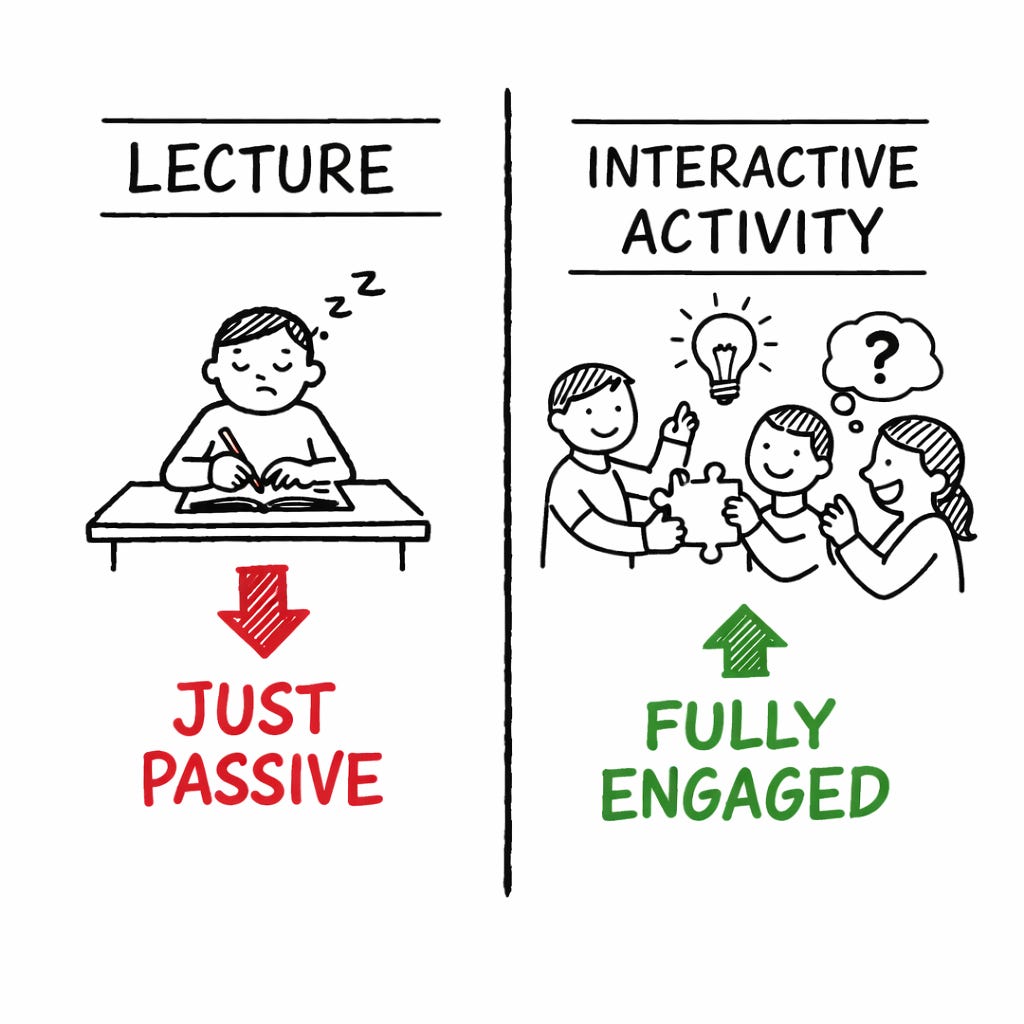
You don’t need four class sessions. You pick the one activity that fits your goals, or you mix two of them into a single session. The point is that you have options, and every option requires students to do something with the material instead of receive it.
Here are the four.
1. The Diagnostic
Too many professors start class by teaching the content. Then they check understanding at the end, if there’s time.
Flip that.
The Diagnostic is a pre-class or class-opening activity that surfaces what students already believe about the topic before they engage with the chapter’s actual content. It exposes misconceptions, overconfidence, and gaps. And it gives you a live map of where your students’ heads are before you teach a single thing.
AI is good at this because it can read a chapter and identify the claims that students are most likely to get wrong or oversimplify. You don’t have time to do that analysis for every chapter. AI does it in 30 seconds.
Here is the prompt.
I’m going to give you a textbook chapter (or my lecture notes) from a college course.
Here’s the context:
→ Course: [Your course name and level, e.g., “Organizational Behavior, undergraduate juniors”]
→ Topic of the chapter: [e.g., “Motivation theories in the workplace”]
→ What students already know coming in: [e.g., “They’ve covered individual differences and personality. This is their first exposure to formal motivation theory.”]
Here’s what I need you to do:
Read the chapter and identify the 8-10 core claims, principles, or frameworks it presents. For each one, evaluate how likely an undergraduate student is to hold a misconception, oversimplification, or incorrect intuition about it before reading.
Then create a Diagnostic Instrument with these specifications:
→ 8-10 statements students rate on a 5-point scale from “Strongly Disagree” to “Strongly Agree.” Each statement should be phrased as a common-sense belief that the chapter’s content either confirms, complicates, or directly contradicts. Mix it up. Some statements should be basically correct. Some should be plausible but wrong. Some should be half-right in a way that matters.
→ For each statement, write a brief instructor note (2-3 sentences) explaining what the chapter actually says about this, why students tend to get it wrong, and what to do with the results in class.
→ Include a suggested 10-minute debrief plan: how to reveal the “answers,” which 2-3 statements to focus class discussion on, and how to transition from the Diagnostic into the main lesson.
Format the student-facing instrument as a clean one-page handout I can print or post to my LMS. Keep the instructor notes separate.
This gives you a 10-minute opening that tells you exactly where your students are confused before you start teaching.
You’re not guessing.
You’re not assuming they read.
You have data from the room, and you can teach to the gaps instead of covering everything equally.
After class, you can show students their original responses and ask them to revise.
The gap between what they believed at 9:00 a.m. and what they understand at 10:15 a.m. is the learning, made visible.
2. The Adversarial Case
Textbooks present concepts as settled. Clean definitions. Tidy frameworks. Three types of this, four stages of that.
Students absorb it and think they understand because they can repeat it. They can’t. Repeating a framework is memorization. Understanding means knowing when it breaks.
The Adversarial Case is a scenario AI builds specifically to stress-test the chapter’s main concept. You hand students a situation where the textbook’s framework doesn’t cleanly apply and ask them to figure out why.
If a student can only use a framework when it works perfectly, they memorized it. Understanding means knowing the boundaries, the edge cases, the conditions where the model falls apart.
Here is the prompt.
I’m going to give you a textbook chapter (or my lecture notes) from a college course.
Here’s the context:
→ Course: [Your course name and level]
→ Topic of the chapter: [e.g., “Supply and demand equilibrium”]
→ The main framework, model, or theory the chapter teaches: [e.g., “The basic supply-demand model with price as the equilibrating mechanism”]
Here’s what I need you to do:
Read the chapter and identify the core framework or model it presents. Then identify the assumptions that framework depends on, the boundary conditions where it starts to break down, and the real-world complications the textbook either glosses over or saves for a later chapter.
Now build an Adversarial Case:
→ Write a 1-2 page scenario (realistic, grounded in a specific company, organization, or situation students would recognize) where the chapter’s framework should apply but doesn’t work cleanly. The scenario should include at least two complications that force students to confront the limits of the model.
→ Do not tell students the framework is failing. Present the scenario as a straightforward application exercise. Let them discover the friction themselves.
→ Write 3 discussion questions:
One that asks students to apply the framework as-is and see where it gets stuck.
One that asks them to identify what the framework is missing or assuming.
One that asks them to modify or extend the framework to handle this scenario.
→ Write an instructor note explaining: what the chapter assumes that this case violates, where students will likely get stuck, how to guide the debrief so students leave with a more sophisticated understanding of the concept (not just “the textbook is wrong”), and what questions to ask to get there.
Keep the student-facing content under 2 pages. Make the scenario specific enough that students feel like they’re in a real situation.
You get an activity where students actually wrestle with the material instead of applying it by rote.
They hit a wall. They have to think about why.
And the debrief conversation that follows is the kind of discussion where students remember what they learned because they earned it.
The adversarial case works especially well for chapters that present models or theories as more universal than they actually are. Which is most chapters.
3. The Stakeholder Simulation
Here is what most classroom discussions look like: you ask a question, three students answer, everyone else waits for the next question.
The Stakeholder Simulation kills that dynamic. AI reads the chapter and creates 4-5 stakeholder roles, each with different priorities, constraints, and information.
Students are assigned roles and have to negotiate a decision together. Everyone has a part. Everyone has a reason to talk. And the decision they’re negotiating requires them to use the chapter’s content as their ammunition.
This forces two things at once.
Students have to understand the concepts well enough to argue from them.
And they have to deal with the reality that the same concepts look different depending on where you sit.
Here is the prompt.
I’m going to give you a textbook chapter (or my lecture notes) from a college course.
Here’s the context:
→ Course: [Your course name and level]
→ Topic of the chapter: [e.g., “Ethical decision-making frameworks”]
→ Class size: [e.g., “28 students”]
→ Session length: [e.g., “75 minutes”]
Here’s what I need you to do:
Read the chapter and identify the 2-3 core concepts, frameworks, or principles it teaches. Then build a Stakeholder Simulation using those concepts as the foundation.
Create a realistic scenario where a decision must be made. The decision should have real stakes and no obvious right answer. The chapter’s concepts should be directly relevant to how stakeholders analyze the situation, but different stakeholders should reasonably reach different conclusions using the same concepts.
Build 5 stakeholder roles:
→ Each role gets a one-page role card with: their name and title, their primary objective, 3-4 key facts or data points only they know, their constraints (what they can’t agree to), and 2-3 arguments grounded in the chapter’s concepts that support their position.
→ Design the roles so that at least two pairs of stakeholders have directly competing interests. No role should be obviously “right.” Every role should have a legitimate case.
→ Include one stakeholder whose position seems weak on the surface but has the strongest argument if they use the chapter’s framework correctly. This rewards the student who actually engages with the material.
Simulation structure:
→ Setup (5 min): I distribute role cards. Students read their role silently.
→ Round 1, Small group caucus (10 min): Students with the same role meet to discuss strategy. What’s their opening position? What are they willing to concede?
→ Round 2, Mixed negotiation (20 min): One representative from each role sits at a negotiation table (fishbowl style or breakout groups). They have to reach a decision. The rest of the stakeholder groups observe and can send written notes to their representative.
→ Round 3, Debrief (15 min): Reveal the “hidden” information across roles. Discuss: what concepts from the chapter did each side use? Which arguments were strongest? Where did the framework help and where did it fall short?
→ Written reflection (5 min): Each student writes one paragraph: “What concept from the chapter did you use most in your role, and how did your understanding of it change during the simulation?”
Also create:
→ A facilitation guide for me with timing cues, common sticking points, and 3 debrief questions that connect the simulation back to the learning objectives.
→ A one-page “situation brief” that all students get before the simulation starts (shared context, no role-specific information).
Format stakeholder role cards as individual one-page handouts I can print and distribute.
What this gives you: a full class session where every student has a job, every student has to use the chapter’s content to do that job, and the energy in the room comes from the competing interests, not from you trying to spark a discussion.
The simulation also surfaces something textbooks rarely address: that the same concept or framework can support opposing conclusions depending on your priorities. That’s a lesson students remember.
4. The Transfer Challenge
This is the one most professors skip, and it’s the one that matters most for long-term retention.
Transfer is the ability to use something you learned in one context and apply it in a completely different context. It’s the whole point of education. And it almost never happens because we teach concepts inside the same domain where they live and never ask students to move them anywhere else.
The Transfer Challenge takes the chapter’s core framework and drops it into a wildly different context. If your chapter is about supply chain management, the transfer context might be hospital emergency room triage. If your chapter is about conflict resolution styles, the transfer context might be international climate negotiations. If your chapter is about cell biology, the transfer context might be organizational design.
The connection isn’t random. AI finds a structural parallel between the chapter’s framework and something in a different field. Students have to figure out where the parallel holds, where it breaks, and what that tells them about the original concept.
Here is the prompt.
I’m going to give you a textbook chapter (or my lecture notes) from a college course.
Here’s the context:
→ Course: [Your course name and level]
→ Topic of the chapter: [e.g., “Project management lifecycle: initiation, planning, execution, monitoring, closing”]
→ What students should be able to do after this session: [Your learning objectives]
Here’s what I need you to do:
Read the chapter and identify the core framework, model, or process it teaches. Break it down to its structural elements: what are the underlying principles, the sequence logic, and the relationships between components?
Now find a structurally parallel situation in a completely different domain. Not a different company in the same industry. A different field entirely. The parallel should be genuine, not forced. The structural similarities should be real enough that the chapter’s framework can be meaningfully applied, but the surface-level differences should be dramatic enough that students have to think hard about what transfers and what doesn’t.
Build a Transfer Challenge:
→ Write a 1-page brief describing the transfer context. Enough detail for students to understand the situation without being experts in that field. Use specific, concrete details.
→ Write three tasks, done in sequence:
Mapping (individual, 10 min): “Identify which elements of [chapter’s framework] have a parallel in [transfer context]. For each parallel you find, write one sentence explaining the connection. Also identify at least one element that does NOT transfer. Explain why.”
Application (pairs, 15 min): “Using the chapter’s framework as your lens, analyze [specific problem or decision in the transfer context]. Where does the framework help you see something you wouldn’t have seen otherwise? Where does it mislead you?”
Reflection (individual, 5 min): “What does this exercise tell you about the framework itself? Is it a universal tool or a domain-specific one? What would you add or change to make it work in [transfer context]?”
→ Write an instructor note with: the specific structural parallels you identified (so I understand the intended connections), where students will likely find false parallels or miss real ones, and 3 debrief questions that push students toward the bigger insight about transfer and abstraction.
The goal is not for students to become experts in the transfer domain. The goal is for them to understand the chapter’s framework well enough to recognize its structure in unfamiliar territory. If they can do that, they own the concept. If they can’t, they only memorized it.
This gives you the activity that separates surface understanding from actual learning. Students who can transfer a framework across domains will remember it next semester. Students who can only use it inside the textbook’s examples will forget it by finals.
This is also the activity that generates the best class discussions, because students find different parallels, argue about which ones are valid, and end up debating the nature of the concept itself. That is the conversation you’ve been trying to start all semester.
How to choose
You don’t need all four for every chapter. You don’t even need two. Pick one. Here’s a quick decision guide.
→ Students haven’t read the chapter and you know it? Start with the Diagnostic. Use the results to decide what to actually spend class time on.
→ Students can define the concept but can’t use it under pressure? Run the Adversarial Case. Let them hit the wall.
→ Your class discussions are flat and the same three people talk? Run the Stakeholder Simulation. Give everyone a role and a reason to engage.
→ Students can pass the test but can’t connect the material to anything outside your course? Run the Transfer Challenge. Find out if they learned it or just stored it temporarily.
You can also combine them. Open with a 10-minute Diagnostic, then run a 40-minute Stakeholder Simulation, then close with a 5-minute written Transfer reflection. One chapter.
One class session.
Three different cognitive modes.
Your review pass
Whatever comes back, check these things before you use it.
→ Does the activity actually require the chapter’s content? Sometimes AI drifts and creates something engaging but disconnected from the learning objectives. Every activity should be impossible to complete well without understanding the chapter’s core concepts.
→ Are the instructions clear enough that a student can start without asking you what to do? This is the most common failure. If students will read the instructions and look confused, tell AI to make them more specific. “What exactly does the student write, build, or decide?”
→ Is the timing realistic? AI underestimates how long things take with real humans in a real room. A “10-minute pair activity” is actually 2 minutes of setup, 10 minutes of work, and 3 minutes of getting the room back. Budget 50% more time than AI suggests.
→ Is the scenario specific enough? Vague scenarios produce vague student work. If the Adversarial Case is about “a company facing a pricing challenge,” that’s too generic. It should be about a specific company, a specific product, a specific market condition. Push AI to add detail.
10 minutes of review. That’s the human-in-the-loop work that turns an AI draft into something that actually works in your classroom.
What to do tomorrow
Pick one chapter you’re covering next week. The one where you already know the current plan isn’t great. Maybe you lecture through it. Maybe you assign it and hope for the best. Maybe you have a discussion planned that you know will be flat.
Copy one of the four prompts above. Paste it into ChatGPT or Claude. Attach the chapter or paste your lecture notes.
Read what comes back. Spend 10 minutes adjusting it. Use it in class. If it doesn’t work, you lost 15 minutes. You’ve lost more than that watching students pretend to take notes on content they’ll forget by Friday.
You have the chapter. You have the prompts. You have 24 hours.
The content in that textbook is fine. Your students don’t need to hear it again. They need to use it in a way their brains can’t ignore.
Right now, your students are stress-testing your lesson plan for you. They’re doing it live, in your classroom, with their attention on the line. You can find out what works before they do.
Follow me on Linkedin for more content.
Consider my services around AI training and integration, curriculum and course development, and strategic consulting and speaking here.
