
Use Temporary Chats
Don't confuse ChatGPT

You just set up your clone using ChatGPT’s memory function.
If you use temporary chat, you can have a conversation with a totally blank slate.
It won’t save the conversation to your history or use them for model training.
It won’t be aware of any previous conversations.
It won’t access or add to your memories.
It’s critical to remember that you will lose any temporary chat once you leave ChatGPT because, well, it’s temporary. So if you want to capture anything in a temporary chat, copy and paste it somewhere before leaving
Maybe you don’t want it’s answer biased by the memory it has of you.
Maybe you’re asking ChatGPT something for a friend, or something that has nothing to do with you.
Maybe you saw a cool Instagram trend of creating wacky images of your dog

or of you as a Garbage Pail Kid card or an action figure


or of your kiddo and their friends as Lego figurines at high school graduation (that’s mine on the left!)
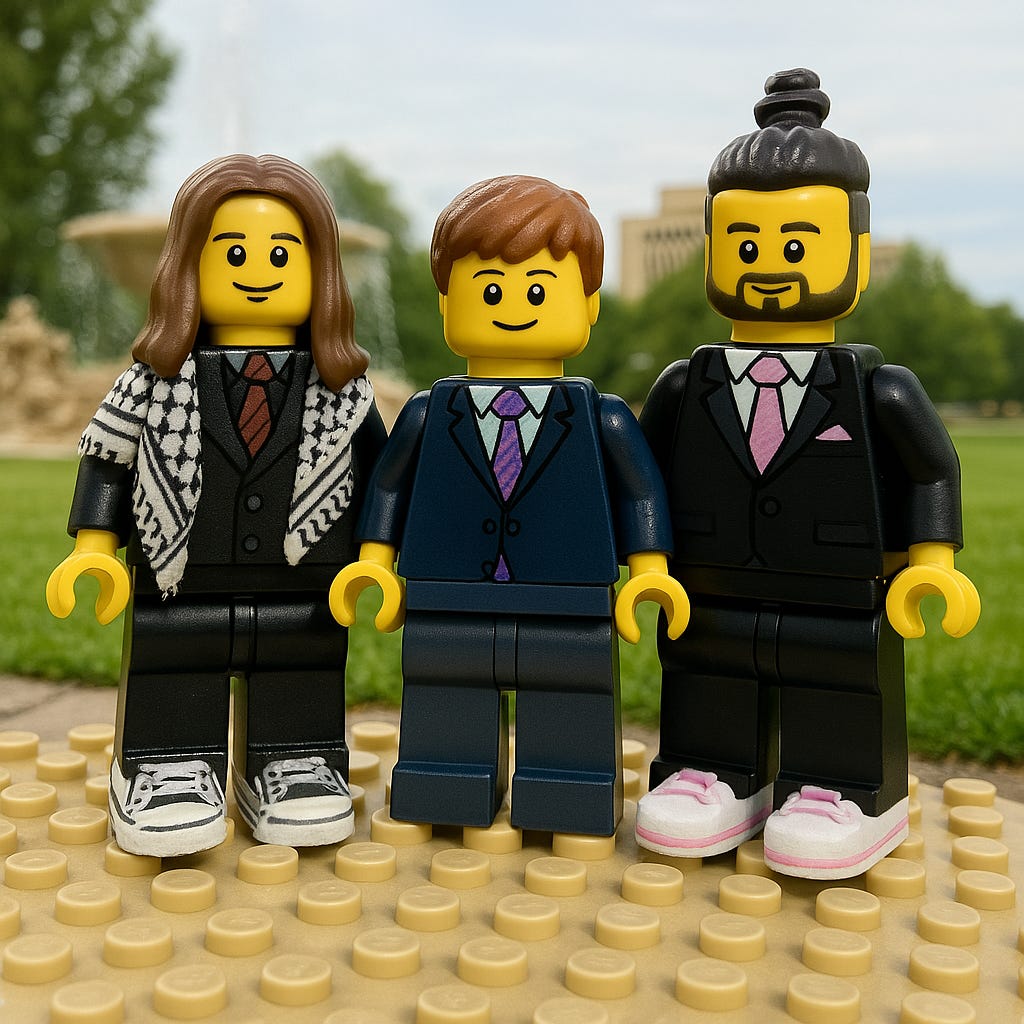
Temporary chats are a great way to keep your clone focused on you.
So let’s actually lock this in.
Below is a quick mini workbook.
3-5 short exercises to dial in how and when to you use your clone and temporary chats.
Do this once.
You will stop confusing ChatGPT.
And you will stop polluting your own memory.
Exercise 1 - Define what your clone is for
Right now your clone is probably “for everything”.
That is how you create chaos and get subpar outputs.
Take a few minutes and answer these questions in a notebook or a new doc:
1. List 5 things your clone should be used for
Think “ongoing you”:
your work
your goals
your writing
your business
recurring projects
your decision making
Examples:
“Help me build a rubric for [assignment].”
“Help me outline a lesson plan for [topic].”
“Help me plan and review [course outline].”
“Help me think through classroom teaching strategy.”
“Help me provide developmental feedback to students.”
2. List 5 things your clone should not be used for
Think “random one-off” or “not really about me”:
fun image creation
one time research for a friend
wild creative experiments not related to your work
sensitive topics you do not want baked into your profile
Examples:
“Looking up [medical stuff]” for your aunt.
“Create an image of my dog as a superhero.”
“Making cursed Barbie-horror crossover scripts for fun.”
“Researching a potential employer I have not told my boss about yet.”
Exercise 2 - Create your 3 default temporary chat use cases
You want presets.
So you are not thinking from scratch every time.
Create 3 buckets:
Stuff for other people
Sensitive or private topics
Wild experiments and play
Now write one reusable starter prompt for each.
You can literally save these as notes and reuse them.
1. For other people
I am asking this for someone else.
Answer as if you know nothing about my preferences or history.
Do not use or update any memory about me.
Treat this as a brand new user.
Here is their context…
2. Sensitive or private
Treat this conversation as separate from my usual chats.
Do not use any memory about me.
Do not save anything from this conversation to memory.
I want neutral, unpersonalized help on a sensitive topic.
Here is the situation…
3. Wild experiments
This is a sandbox.
Ignore any memory about my usual tone, style, or preferences.
Propose ideas you would never suggest if you were trying to stay ‘on brand’ for me.
Here is what we are playing with…
You don’t have to use these word for word.
The point is to have default “entry points” you can drop into a temporary chat.
Exercise 3 - Audit your last 10 chats
This one might hurt a little. Do it anyway.
Open ChatGPT.
Look at your last 10 non-temporary chats.
For each chat, assign it to one of three categories:
✅ “This belonged in my clone. Good it lives in memory.”
❌ “This should have been a temporary chat.”
❓ “I am not sure, it’s mixed.”
Pay attention to the ❌ and ❓ ones.
For each of those, ask:
Was this really about “ongoing me”?
Would I want this shaping my answers 6 months from now?
Did I dump emotion, venting, or drama into the clone that I do not want baked in?
Write down any patterns you notice, for example:
“I use my clone to vent about work way too much.”
“I test dumb creative ideas in the same place I do serious work.”
“I keep asking questions for other people inside my own profile.”
This is where you see how you are actually using the tool, not how you think you are using it.
Exercise 4 - Make your personal “routing rule”
You’ve done the hard work to isolate your clone.
Now turn all of that into one simple rule you can remember.
Something like:
If this is part of my long term work, goals, or identity, I use my clone. If it is just for fun, sensitive, for someone else, or I would be annoyed it lives in my profile in 6 months, I use temporary chat.
Write your own version in one or two sentences.
Put it somewhere you will actually see it. (A sticky note on your computer works best for me.)
The goal is to make “clone or temporary chat?” a fast reflex, not a debate.
Exercise 5 - Promote only the gold
Last step.
Temporary chats are a sandbox.
Your clone is the library.
You do not want to dump the whole sandbox into the library.
Do this once this week:
Start a temporary chat for something you care about.
a plan you are designing
a reflection on last month
a decision you are considering
Work it through in temporary chat until you get one or two clear insights, decisions, or frameworks.
Copy only those 1-2 useful parts into your main clone chat and say:
Update your memory with the following snippet, using only and exactly these words:
[PASTE ONE SNIPPET COPY]
Examples:
“I want you to treat my writing voice as [description] going forward.”
“I have decided that my main focus for the next 90 days is X, not Y.”
“I am done taking on new clients in [area] after this month.”
You are training the clone on curated outputs, not raw noise.
Do these five exercises once.
You will know:
what your clone is for
what temporary chats are for
how to keep your memory clean
how to promote only the good stuff back into your long term AI “brain”
That is the difference between “I use ChatGPT sometimes” and “I have an actual system that gets better every week.”