
Implementing HUMAN Skills Studio Framework, Phase 2
Expand to a Mini-Portfolio and 3 Assignment Patterns

In previous posts, I introduced the HUMAN Skills Studio Framework, a practical framework to guide teachers in how to guide college students in using generative AI technology (like ChatGPT) in ways that enable them to deeply develop their human skills (what most folks call “soft skills”), and laid out:
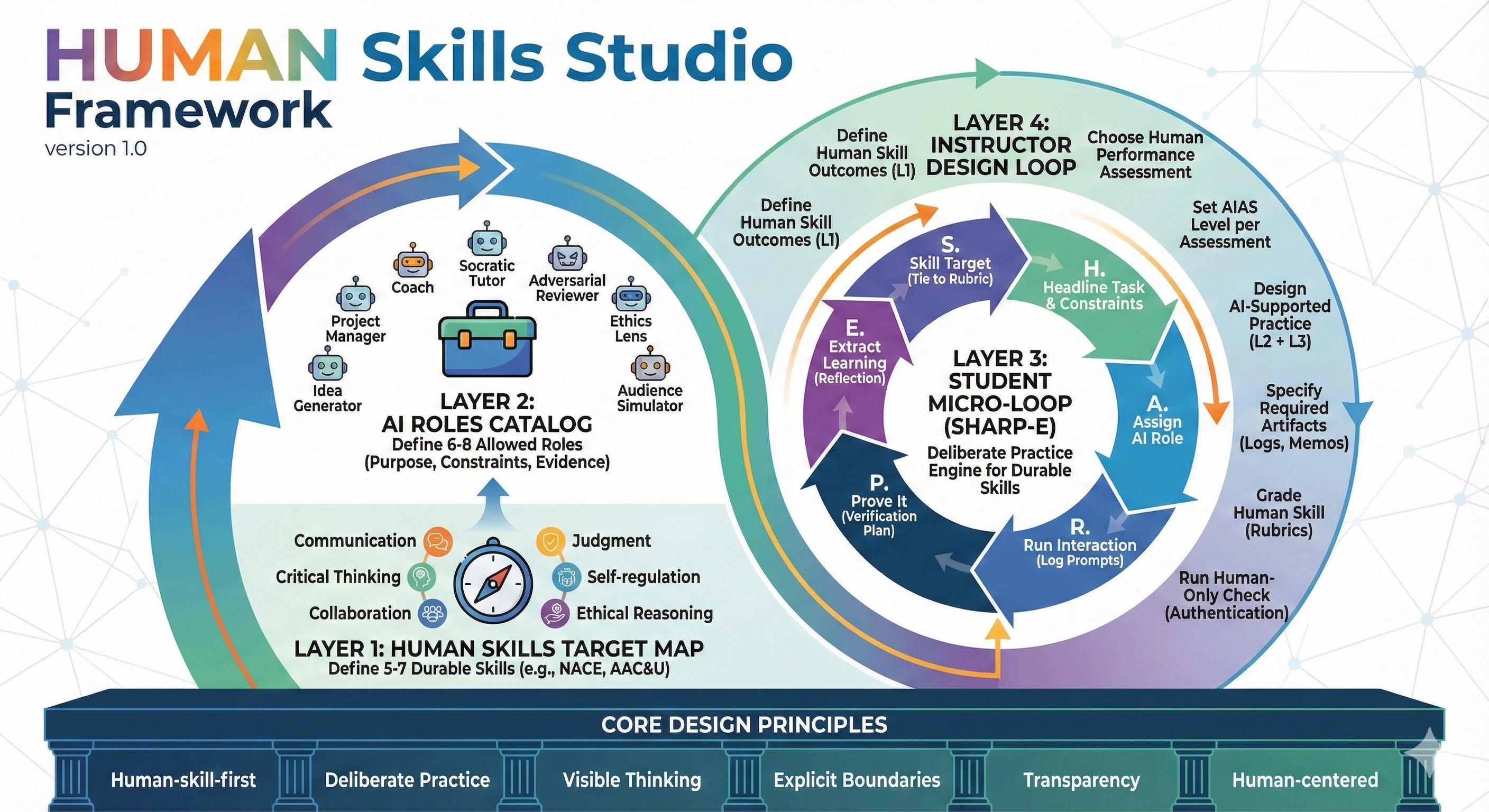
Phase 2: Expand to a Mini-Portfolio and 3 Assignment Patterns (Months 5–7)
Goal
Shift from one-off pilot to repeatable practice engine.
Phase 1 gave you a proof of concept: two labs, one assignment, evidence that the loop can work.
Phase 2 scales that proof into a system.
By the end of this phase, students will have repeated reps across multiple skills, a growing portfolio documenting their development, and three different assignment patterns training human performance.
The key shift:
Phase 1 asked “Can this work?” Phase 2 asks “Can this become routine?”
The Rationale: Why Repetition Matters
Here’s what cognitive science tells us about skill development:
spacing beats cramming
When learning is distributed over time with gaps between practice sessions, retention improves dramatically compared to massed practice.
The mechanism is straightforward. When your students return to material after a gap, their brain has to work harder to retrieve it, which strengthens the memory trace.
This has direct implications for HUMAN Skills Studio:
One verification lab teaches the concept
Two verification labs start building the habit
Four verification labs (spaced across the semester) make the skill durable
Phase 2 increases lab frequency specifically to leverage the spacing effect and to exploit how human memory actually works.
Month 5: Establish Weekly or Biweekly Lab Rhythm
Deciding Your Cadence
Choose based on your course structure:

Spacing matters more than total time.
Four 20-minute labs spread across a month will produce better retention than one 80-minute session.
Lab Design for Consistency
Every lab should follow the same four-part rhythm from Phase 1:
Model (5–10 min): Demonstrate the skill and AI role
Paired Practice (15–20 min): Students run SHARP-E in pairs
Human Performance (10–15 min): No-AI demonstration of skill
Reflection (5 min): Brief capture of learning
Consistency matters. Students should know what to expect.
The predictable structure reduces cognitive load and lets students focus on skill development rather than figuring out what’s happening.
A Sample Lab Sequence for Phase 2
Here’s how you might sequence 6–8 labs across Months 5–7, cycling through your Human Skills Map:

Notice the pattern: skills return with increased complexity.
Lab 5 deepens verification; Lab 9 applies verification to peer work.
This spiraling leverages spaced practice while building toward more sophisticated application.
What Changes from Phase 1 to Phase 2

Month 5–6: Introduce the Mini-Portfolio
What Is the Mini-Portfolio?
The mini-portfolio is a collection of 3 “episodes” documenting the student’s skill development with AI.
Each episode is a complete cycle: a skill practiced, an AI role used, evidence gathered, reflection written, and a human performance artifact produced.
Unlike a showcase portfolio (best work only), this is a developmental portfolio. It shows growth over time. Students don’t curate for polish; they curate for learning.
Why Portfolios Work
Research on portfolio assessment consistently finds that portfolios:
Build self-regulation skills as students select and justify evidence
Enable authentic assessment by collecting diverse evidence types
Capture growth over time rather than a single performance snapshot
Promote metacognition by requiring students to reflect on their own learning processes
Portfolios are particularly effective when they include a reflective component explaining why selected evidence demonstrates learning.
The reflection does the cognitive work because it forces students to articulate what changed and why it matters.
Episode Structure
Each portfolio episode includes six components:
1. Skill Targeted: Which skill from your Human Skills Map is this episode documenting?
2. AI Role Used: Which role(s) from your AI Roles Menu did the student use? Why this choice?
3. Selected Prompt Evidence: 1–3 prompts that show the student’s AI interaction.
4. Verification Notes: What did the student verify? What discrepancies were found? What was corrected or rejected?
5. Reflection: A brief (150–300 word) reflection answering:
What did I do well in this episode?
What would I do differently next time?
How is this skill developing compared to earlier in the course?
6. Human Performance Artifact: Evidence of the student demonstrating the skill without AI. Options include:
Notes from live role-play
Handwritten in-class work
Peer feedback form from facilitation
Recording of oral defense or explanation
Critique memo written under controlled conditions
Timing the Episodes
Spread three episodes across Months 5–7:

Each episode should connect to graded work. This creates natural accountability and integrates the portfolio into existing course structure rather than adding separate deliverables.
Portfolio Submission and Review
Submission format: Digital is easiest. A shared folder (Google Drive, OneDrive) or LMS portfolio tool works. Students add episodes progressively; you review at milestones.
Review approach:
After Episode 1: Quick check for completeness and format
After Episode 2: Substantive feedback on reflection quality and skill development
After Episode 3: Full portfolio review comparing growth across episodes
This staged review prevents end-of-semester grading crunch and gives students formative feedback they can use.
What You’re Looking For
When reviewing portfolios, ask:
Evidence of process: Do the prompts and verification notes show genuine engagement, or checkbox compliance?
Reflection quality: Does the student identify specific behaviors (not just feelings)? Do they notice change over time?
Human performance: Does the artifact show capability independent of AI?
Growth trajectory: Is Episode 3 more sophisticated than Episode 1? In what ways?
The goal is visible learning.
Month 6–7: Add Two More Assignment Patterns
Why Three Patterns?
Phase 1 piloted one assignment pattern. Phase 2 adds two more.
By the end, your course includes three different assessment types that force human performance.
Why three?
Transfer: Students who only practice one pattern may not generalize skills to new contexts
Variety: Different skills are better assessed through different formats
Equity: Students have different strengths; multiple patterns give more opportunities to demonstrate capability
Selecting Your Additional Patterns
Return to the three pilot patterns from Phase 1:
Adversarial Argument Clinic – develop position with AI, defend it live
Stakeholder Role-Play Rehearsal – prepare with AI, perform without it
Verification Sprint (Extended) – make verification the assessed skill
If you piloted one, add two others. Or design your own patterns that fit your discipline, following these principles:
Pattern Design Principles:
Students can use AI extensively for preparation (AIAS Level 3–4)
A human performance component is required where AI cannot assist (AIAS Level 1)
The human component is weighted at 40% or higher
Process artifacts are required and graded
Additional Pattern Options
If the three core patterns don’t fit your discipline, consider these alternatives:
Pattern 4: Critique and Revision Cycle
Best for: Writing-intensive courses, design courses, any course emphasizing iterative improvement
Human skill focus: Self-evaluation and revision judgment
Structure:

Grade breakdown:
Initial draft: 15%
Self-critique quality: 25%
Revision plan: 20%
Oral defense: 40%
Why it works: Students learn that AI critique is useful but incomplete. The self-critique forces metacognition; the oral defense reveals whether they understand their own revision choices.
Pattern 5: Teaching Demo
Best for: Any course where explanation is important (STEM, humanities, professional programs)
Human skill focus: Explanation and adaptive communication
Structure:

Grade breakdown:
Teaching plan: 20%
Live demo: 50%
Q&A response: 30%
Why it works: You cannot explain what you don’t understand. AI can help you prepare, but the live demo reveals true comprehension. The Q&A adds unpredictability that rewards deep understanding.
Pattern 6: Collaborative Problem-Solving
Best for: STEM courses, case-based courses, any course with complex problems
Human skill focus: Real-time reasoning and collaboration
Structure:

Grade breakdown:
Preparation evidence: 15%
Group solution: 35% (group grade)
Individual oral walk-through: 50% (individual grade)
Why it works: The novel problem prevents memorization. The oral walk-through ensures individual accountability within group work. AI helps preparation but cannot solve the new problem for them.
Sequencing Your Three Patterns
Spread the three patterns across the semester to maintain spacing:

Each assignment connects to a portfolio episode, creating coherence between assessment and documentation.
The Assessment Design: Separate Your Scores
In Phase 1, you created a rubric with three dimensions. In Phase 2, you make these dimensions explicit and consistently applied across all graded work.
The three dimensions:
Human skill performance: The observable behavior from your Skills Map
AI process quality: Role choice, verification, critical engagement, transformation of AI output
Integrity and transparency: Accurate disclosure, AIAS compliance, data care
When these are collapsed into a single grade, students optimize for whatever seems to drive the final number. When they’re separated, students see that each dimension matters independently.
Implementing Separated Scores
Option A: Weighted Components
Report a single grade, but show students the component breakdown:
Assignment #2 Grade: B+

Human Skill Performance (50%): A-
- Clear synthesis of sources
- Oral explanation showed strong understanding
- Minor gaps in stakeholder perspective-taking

AI Process Quality (30%): B+
- Appropriate role selection
- Verification present but shallow in places
- Good transformation of AI output

Integrity/Transparency (20%): A
- Complete disclosure
- AIAS Level 3 followed appropriately
- All required artifacts submitted
Option B: Separate Grades
Report three separate grades or scores:

This makes each dimension maximally visible but requires gradebook configuration.
Option C: Hybrid
Human skill performance gets a letter grade. AI process and integrity are pass/fail. Students must pass both to receive credit for the human skill grade.
This emphasizes that human skill is the primary target while maintaining accountability for process and integrity.
Calibrating the Weights
The weight distribution signals what matters. Consider:

Adjust based on assignment goals. An early assignment might weight integrity higher to establish norms. A capstone might weight human skill higher because norms are established.
Evidence Collection: Building the Case
Continuing Your Evidence Streams
Maintain the three streams from Phase 1:
Stream 1: Pre/Post Skill Self-Rating
Already collected pre-ratings in Phase 1
Collect mid-point ratings at end of Month 5
Collect post-ratings at end of Phase 2 (Month 7)
The mid-point adds a data point. You can now see: Pre → Mid → Post trajectory for each skill.
Stream 2: One-Minute Reflections
Continue collecting after each lab
With 6–8 labs, you’ll have substantial qualitative data
Look for patterns: Which skills show confidence growth? Which remain challenging?
Stream 3: Compliance Metrics
Track across all three assignments
Look for improvement: Is compliance higher in Assignment #3 than Assignment #1?
New Evidence Stream: Portfolio Analysis
The mini-portfolio provides a fourth evidence stream:
Stream 4: Episode Comparison
For a sample of students (10–15), compare:
Episode 1 reflection vs. Episode 3 reflection: Is reflection more specific? More self-aware?
Episode 1 verification notes vs. Episode 3: Is verification more thorough?
Episode 1 human performance vs. Episode 3: Is performance quality higher?
Document specific examples of growth. These become your evidence that the system produces skill development, not just compliance.
What Counts as Success?
At the end of Phase 2, you’re looking for signals in four areas:

You’re looking for enough signal to justify continuing and refining.
Workload Management: Keeping Phase 2 Sustainable
The Sampling Approach (Expanded)
With three assignments and 3 portfolio episodes, grading load increases. Protect yourself:
Assignments: Continue grading 20–30% of process artifacts deeply. Spot-check the rest.
Portfolio Episodes:
Episode 1: Completion check only (5 min per student)
Episode 2: Substantive feedback on 50% of students (10 min each); completion check on rest
Episode 3: Full review of all portfolios (15 min each), but use rubric to constrain scope
Labs: Don’t grade individual lab participation. Collect one-minute reflections but scan for patterns rather than grading individually.
Time Estimates for Phase 2

Total estimated Phase 2 investment: 40–50 hours across 3 months
This is significant, roughly 3–4 hours per week. But it replaces other grading (traditional essays, exams) and produces better evidence of learning.
If 40–50 Hours Is Too Much
Scale down strategically:
Reduce lab frequency: Biweekly instead of weekly (saves 2–3 hours)
Simplify portfolio: 2 episodes instead of 3 (saves 5–7 hours)
Streamline Episode 3 review: Use rubric with minimal written feedback (saves 2–3 hours)
Fewer deep-graded artifacts: Grade 15% deeply instead of 25% (saves 2–3 hours)
The minimum viable Phase 2: biweekly labs (4 total), 2 portfolio episodes, 2 assignment patterns. This cuts time roughly in half while maintaining the core system.
Common Phase 2 Challenges (and Solutions)
Challenge 1: Students Don’t Take Portfolio Seriously
Symptom: Episode submissions are minimal, reflections are generic, artifacts are missing.
Solution:
Make portfolio grade-bearing (even 5–10% of final grade creates accountability)
Provide feedback on Episode 1 that students can use for Episode 2
Show exemplar reflections (anonymized) so students see what “good” looks like
Challenge 2: Labs Feel Repetitive
Symptom: Student engagement drops after Lab 3; paired practice becomes perfunctory.
Solution:
Vary the AI role across labs
Increase complexity (Lab 6 should demand more than Lab 1)
Add peer verification or peer feedback components
Let students choose their topic/question for later labs
Challenge 3: Separated Scores Confuse Students
Symptom: Students don’t understand how their grade was calculated; complaints about process grades.
Solution:
Explain the three dimensions in your syllabus and first-day overview
Show worked examples of how separated scores produce final grades
Provide component-by-component feedback on first graded assignment
Be consistent across all assignments (same dimensions, same weights)
Challenge 4: Human Performance Takes Too Long to Assess
Symptom: You’re spending 10+ minutes per student on oral components; schedule is impossible.
Solution:
Shorten oral components to 5 minutes max
Use structured question sets (same 3 questions for all students)
Record oral components and grade asynchronously
Use peer assessment for some human performance components (with calibration)
Challenge 5: Growth Isn’t Visible in Portfolios
Symptom: Episode 3 looks like Episode 1; reflections don’t show development.
Solution:
Require students to explicitly compare current episode to previous episodes
Ask specific comparison questions: “What can you do now that you couldn’t do in Episode 1?”
Provide feedback on Episode 2 that identifies specific growth areas to document
Phase 2 Milestone Checklist
By the end of Month 7, you should have:
Established weekly or biweekly lab rhythm (6–8 labs completed)
Collected 3 portfolio episodes from all students
Graded 3 assignments using separated scoring (human skill / AI process / integrity)
Collected mid-point skill self-ratings
Maintained compliance metrics across all assignments
Analyzed sample portfolios for evidence of growth
The Key Milestone Statement
You should now be able to say:
“Students have repeated reps across multiple skills. They have a growing portfolio documenting their development. The course is now measurably training skills, not just ‘allowing AI.’”
If you can say this with evidence, Phase 2 succeeded. You’ve built a practice engine.
What Comes Next
Phase 3 (Months 8–10) makes HUMAN Skills Studio the course operating system. You’ll:
Expand to a full 5–7 episode portfolio
Make AI roles part of classroom language
Implement at least two authentic human performances that matter for the grade
Add external feedback to increase validity
Design against gaming through portfolio-grade linkage
The shift from Phase 2 to Phase 3 is about depth and integration.
Phase 2 added components. Phase 3 makes them coherent.
But that’s later. Right now, focus on making repetition routine. Your goal is a system students can predict and a portfolio that shows growth.
Practice doesn’t make perfect.
Practice makes permanent.
Make sure what’s becoming permanent is the right thing.
Follow me on Linkedin for more content.
Consider my services around AI training and integration, curriculum and course development, and strategic consulting and speaking here.

Couldn't agree more. This routine shift, as you explained before, is genious for AI education.